
How long does it take to brick a house?
When the bricks arrive, the anticipation builds too
We get it. You’ve been waiting for this moment to arrive, and now that it has, the desire to get into your new home and make it uniquely remarkable is huge. So here’s where we’re at. The slab has been laid, underground services have been carefully installed, and now the bricks are scheduled to arrive on site. But before we get to how long it takes to brick a house (the suspense, right?!), we’ve got a few details to share with you.
Locally sourced and made for South Australian homes
The bricks used to build your home are typically manufactured here in Australia, often using locally sourced clay and produced in a range of natural colours and finishes.And they’re headed straight to your homesite.
Best part? It doesn’t stop there. Many of the materials used throughout the build are sourced locally where possible, from door frames and window frames to flashings, brick ties, and tie-down straps (you know, the ones that help keep the roof exactly where it should be).
The more locally sourced materials we can use, the better in our books.
Once the materials arrive…
It’s time to assemble the team (aka the legends who turn your vision into a real-life home). Now you’ll start to see your future home really take shape. The first big visual step? Brickwork. This stage is significant because, aside from holding up your home, the brickwork determines the size and location of rooms, passageways, doors, and windows. It’s the moment when those drawings start turning into actual spaces you can walk through.
What’s so remarkable about bricks?
Quite a lot actually. (Just don’t let us corner you at a party. We’ll talk about bricks all night.)
Here’s the executive summary:
Bricks have excellent thermal mass, meaning they help keep homes cooler in summer and warmer in winter, something South Australian homeowners definitely appreciate.
They’re also:
- Great sound insulators
- Extremely durable
- Highly fire resistant compared to many lightweight building materials
So yes… bricks are pretty remarkable.
And generally speaking, there are two main types used in construction.
Face bricks
Face bricks are used on the visible exterior parts of your home, particularly the front elevation. They’re manufactured with aesthetics in mind and come in a wide range of colours, textures, and finishes.
Perfect for creating that standout street appeal.
Internal bricks
Internal bricks (sometimes called utility bricks) are structural bricks used for internal walls.
You won’t see them once the home is finished because they’ll be plasterboarded over, but they play a crucial role in supporting the structure of the home. In other words, pretty important when it comes to keeping the roof where it belongs.
The checklist of brick benefits
Okay, here we go:
- Clay bricks can handle the knocks of everyday life and harsh weather conditions
- They won’t fade, twist, warp, rot, decay, or dent
- Termites can’t eat them (major win)
- They’re low maintenance and don’t need painting or coatings
- Double brick construction provides excellent thermal performance
- Their density helps reduce noise between rooms and from outside
- They come in a huge variety of colours, textures, sizes, and shapes
So you’ve got plenty of design options to make your home uniquely yours.
So, how long does it take to brick a house?
Fun fact: a skilled bricklayer can lay up to 600 bricks a day.
But when it comes to the full bricking stage, the timeframe depends on the size and complexity of the home.
For most homes, brickwork typically takes around 7–10 days to complete.
Once the brickwork is finished, the next major milestone is roof cover, which means your home is officially taking shape.
Make it an experience (because why not?)
This is no ordinary new home journey.
And you didn’t choose an ordinary home builder.
So why not make the most of it?
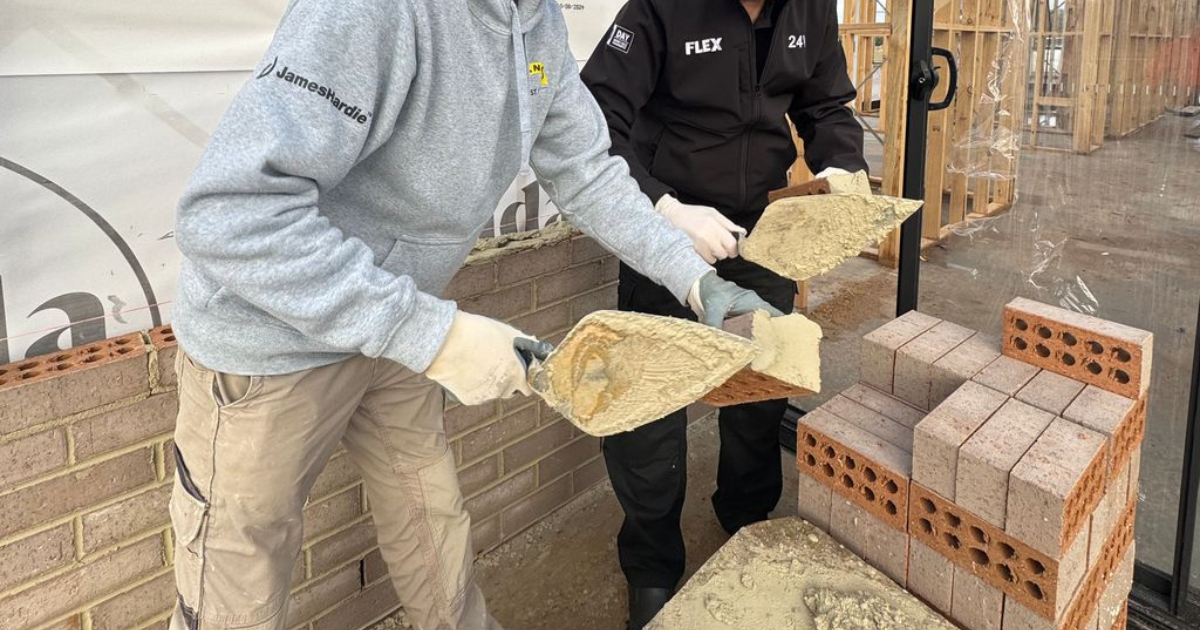
At this stage, you’ll often have the opportunity to visit the site and lay a brick inside your home.
Write your name. Add an inspirational quote. Go full glitter glam if that’s your thing.
Don’t worry, these are internal bricks, so once the plasterboard goes on, your masterpiece will remain your little secret.
Once you’ve finished mastering your new trade (or deciding to leave it to the professionals), the roof cover goes on and your future home starts looking even more like… well, a home.


